


16 years ago

Section -1 : Answer each question in about 500 words.
1. What do you understand by the term faudalism? Do you think the western Europe model of feudalism is appliacble to India?
Ans:- Before the rise of national states in Western Europe, the people lived under a system called feudalism. This was a social system of rights and obligations based on land ownership patterns.
Each small district was ruled by a duke, count, or other noble. The noble's power was based on the land he held in feud. This peculiar system of landholding determined the pattern of government. It also gave rise to fortified castles, knights in armor, and chivalry. The term "feudalism" therefore describes an entire way of life.
The system of feudalism was established gradually, between the 8th and 11th centuries. France was the land of its earliest and most complete development, but in some form or other it was found in all the countries of Western Europe. It flourished especially from the 11th to the end of the 13th century. There are survivals of feudalism in the laws and social usages of modern European countries.
No,it is highly improbable that European feudalism is applicable in India.
Feudalism had begun as a contract, the exchange of land tenure for military service. Over time, as lords could no longer provide new lands to their vassals, nor enforce their right to reassign lands which had become de facto hereditary property, feudalism became less tenable as a working relationship. By the thirteenth century, Europe's economy was involved in a transformation from a mostly agrarian system to one that was increasingly money-based and mixed. The Hundred Year's War instigated this gradual transformation as soldier's pay became amounts of gold instead of land. Therefore, it was much easier for a monarch to pay low-class citizens in mineral wealth, and many more were recruited and trained, putting more gold into circulation, thus undermining the land-based feudalism. Land ownership was still an important source of income, and still defined social status, but even wealthy nobles wanted more liquid assets, whether for luxury goods or to provide for wars. This corruption of the form is often referred to as "bastard feudalism". A noble vassal was expected to deal with most local issues and could not always expect help from a distant king. The nobles were independent and often unwilling to cooperate for a greater cause (military service). By the end of the Middle Ages, the kings were seeking a way to become independent of willful nobles, especially for military support. The kings first hired mercenaries and later created standing national armies.
The Black Death of the fourteenth century devasted Europe's population but also destabilised the economic basis of society. For instance, in England, the villains were much more likely to leave the manorial territory - seeking better paid work in towns struck by a labour shortage, while the crown responded to the economic crisis by imposing a poll tax. The resulting social crisis manifested itself in the peasants' revolt.
Historian J. J. Bagley notes that the fourteenth century
"marked the end of the true feudal age and began paving the way for strong monarchies, nation states, and national wars of the sixteenth century. Much fourteenth century
2. Discuss the main threats to the eco-system.
Ans:-
There are broadly activities of man which are causing considerable damage to the eco-system.
These are -
(1) The destruction of tropical rain forests.
(2) Establishment of petro-chemical industries with their production of poisonous gases, chemicals and other toxic substances.
(3) Generation of nuclear power and
(4) Excessive, militarism.
The long-term solution of these dangers is to look for self-sustaining life support systems.
(5) Ecological crises will take place. Ecological crises, essentially refers to the disruption in the natural balance between living organisms and their surrounding, by the activities of man. Man has acted as an interventionist, so the say, and disrupted the surrounding. This had created q crises.
(6) If ecological crisis will takes place then firsly there is the danger from poisonous chemicals, and pesticide, secondly there is danger from cereal is called the 'Green House Effect'. This leading to increasing a accumulation of carbon dioxide in the atmosphere.
(7) Environment, degration and environmental aduteration would take place in very lhigh manner.
Section 2 : Answer each question in about 250 words.
3. What is meant by 'Market Failure'? Briefly discuss the major weaknesses of the free market economy.
Ans:- A county's economic health and property depend on health of its market. The market is controlled by what is controlled ny what is called 'market Forces' When these forces work in unison, in harmony and in the interest of people and the nation, the market remains healthy. The demand and supply of all commodies match as closely as possi8ble and keep the prices steady. However, there do come times when total market failuare takes places.
Market Failuare is a situation when industries get closed. Already produced good is stored, the demand of the commodities almost decreased, share markets are also closed, the problem of unemployement increased in the country and the economy became totally disturbed. In 1992 that type of market failure had takes place.
FreeMarket:- This is the type of market in which commodities are sold are purchased without the interterms. They are free to produce any amount of the product and at any price.
There is no interference of Govt. in free market so the problem of black marketing takes place. Capital class exploit the weaker section so the capital class rich day per day & the poor class weak play per day, purchasing power of customer reduced day by day because of higher prices. Producers run the market as per their desire for earing maximum profit. The buseness of money lords grow and the economy weak day by day. Corruption less supply of product in the market, maximum profit, monopoly are the main wakness of the free market economy.
4. Describe the role of intellectuals up to the end of the 19th century India.
Ans:- If we don't look this aspect from a preoccupied thought, then we will find that the role of intellectuals is immense.Right from the time of Raja Ram Mohun Roy, who seriously pursued Sati abolition cause to Dada Bhai Nouroji who put forward the drain theory. In the middle of the nineteenth century, intellectuals played a key role for the cause of Indigo cultivators during the indigo revolution of Bengal in 1859-60, by writing petitions and filing court cases and filling forms for the illiterate cultivators.
one can find numerous such incidents. The success these intellectuals managed to get, is also behind our present faith fro Right to information and Indian way of doing things through petitions
5. Why do we require an independent judiciary in a federal setup?
Ans:- The guiding principle behind federalism is independence of government branches. This allows no single branch to decide the direction of the country, and with checks and balances there is a greater chance that the rights of the individual, especially those who are in the minority, will be protected from the will of the majority. An independent judiciary is vital to such a set up because it takes the laws created by the legislature and interprets them against the legal backdrop of the Constitution, without being swayed towards an interpretation favored by another branch. Once the judiciary becomes a pawn of another government branch, the delicate balance created by a three-branch government fails, and a small group can impose its will over the majority. The most important function of the judiciary is to ensure that the rights guaranteed by the nation's constitution are enforced. Once I cheat by having someone else do my homework, the whole system falls. An independent judiciary prevents a government from using the important matters of the day to justify illegal and immoral actions against the minority by passing and enforcing laws contrary to the ideals on which a nation is founded.
6. What do you understand by "urbanism"? Discuss its impact.
Definition: Urbanism is the word used by archaeologists to describe the process that drives people to live in cities. Cities are defined by their size (generally greater than 5,000 people), and the existence of a series of complexity traits, including such things as a central administration or government, and the segregation of people by class and/or occupation.
We assume, but don't really have a way of knowing, that people congregated together for protection, or to facilitate public projects like irrigation systems or the construction of large buildings. Living in clumps has problems that must be resolved for cities to continue, including the transport of food produced elsewhere into the city limits, and rubbish and sanitation transported outside.
Question 3 : Answer in about 100 words each.
7. Write short notes on any two of the following:
i) The Enclosure Movement
The Enclosure movement in
i) The first wave came in the 16th and 17th centuries. During this period small peasants and tenants were evicted from land by land lords. The reason was that the latter had enclosed or fenced in large plots of land for breeding sheep to get wool for the expanding woollen textiles market.
ii) The second wave came in the 18th and 19th centuries. The enclosures began to be macle to improve cultivate land as a business proposition.
In the latter development the land owner evicted the peasants by special licence from the king or the private Acts of Parliaments (there are 2700 such Acts in 1700-1844) and other methods. As a result in 1883 in
ii)Slavery in ancient India.
iii) The process of Sanskritisation
Sanskrit is the mother language of almost all Indian languages and also some out of Indian languages like Bhasha of Indonesia.
Sanskrit is the oldest language in the world and also richest in classic literature. However it was neglected in the last 1000 years of alien rule.
The process of sanskritisation means giving again the status of eminence to sanskrit as it had always enjoyed. The students are now encouraged to take sanskrit as a subject from early days. In every state a sanskrit academy has been set up special sanskrit Universities, like Lal Bahadur Shastri Sanskrit Universities have been set up. Government has sponsered correspondence courses of sanskrit learning. Also, there are regular news broadcasting radio and telecast on TV, some times also have been produced in sanskrit.
Thus sanskritisation is in the process in education, radio, TV, films, science, technology Government offices etc. actively supported by the Government.
iv) Communal award of 1932

Question 1 :- Explain in datail all the items/options on the menu bar and tool bar of any internet Browser (Internet Explorer or Netscape Navigaror).
Ans:-
INTERNET EXPLORER 6
Microsoft internet Explorer 6 is web browser. It provides access to web pages across the internet and has many different componenets.
Defination:-
There are some terms commonly used to reference objects on the Internet or within Internet Explorer.
The toop bar:-
The toolbar is at the top of the window and is divided into the menubar and the navigation bar.
Navigation bar :- The navigation bar is filled with icons representing different options a user can perform to navigate about the internet.
-- The Back button : Used to go back to the last page viewed. You can press back multiple times.
-- The forward button : Used to go forward through previously viewed pages. Both the back and forward buttons have a drop down menu (the little black triangle) next to each button. These will pull down a selectable list of all of the previously viewed page.
-- The stop button : used to stop downloading a webpage.
-- The refresh button : Used to re-downloading a webpage.
menu bar : The menubar contains the menus for accessing different features of Internet Explorer. The menu categories are
File, Edit, view, Favorites, Tools and help. File menu :
-- New : A new window will open another instant of Internet Explorer.
-- Open : Allow the user to view a website or a folder on the user's computer.
-- Save as : Allows the user to save the current page locally to hard drive.
-- Page Setup : Opens up a setup window with options for customizing the look of a printout of the page.
-- Print : Prints the current page with the containts given in page setup.
-- Send : Send is a submenu with options that allows a user to email the current page, a link to the page, or create a shortcut on the desktop.
-- Close : Closes the instance of internet Explorer.
Edit Menu :
-- Copy : Copies the selected contents to the clipboard.
-- Select All : Selects all contents on the page.
-- Find on this page : Opens a search box to search for some text on the current page.
View Menu :
The view menu has a number of functions tailored to the looks of Internet Explorer.
-- Toolbar : A submenu with options for showing different toopbar. Placing a check next to each options enables them and makes them visible.
-- Status Bar : The status bar at the buttom of the window. It display information about various aspects of Internet Explorer.
-- Explorer Bar : A submenu with various explorer options. Search opens a search box to search the internet. Favorites opens a window of all the user's saved favorites. History opens a list of all the websites a user has visited on the last few weeks.
-- Goto : A submenu for jumping to a previously viewed page. Identical function to the back and forward in the navigation bar.
-- Stop : Stops the current page from laoding. Identical to the stop button in the navigation bar.
-- Text Size : Maches the size of the page larger or smaller.
-- Encoding : Allows the user to pick a language that may be displayed on the page.
-- Source : Show the source HTML code for cuttent page.
-- Full screen : Puts Internet Explorer to koisk mode.
Favorite Menu :
The favorites menu provides a means of saving websites that a user finds useful or interesting. When the user wants to re-visit that site at a later date, they can simply click on the saved favorite and it will godirectly to the corresponding page.
-- Add tp favorites : Opens up a box asking where to save a favorite for the currently displayed page. The user may opt to categorize their favorites into subfoldrs.
-- Organize favorites : A box for moving favorites to various sub folders within the favorites menu.
Tools Menu :
Within the tool menu, there is a option called Internet Option.
The Internet options window is split up inot 7 tabs.
-- General Tab : It has options to set the user's homepage, clear out temp file, and clear the history cache.
-- Security Tab : It has many different security settings. Setting set too low may leave a user vulnerable to attack by hackers, setting too high may render some stes non-funtional. As a rule of thum the default of medium is a safe place to leave this setting.
-- Content Tab : Contains settings for content filtering. Auto complete is an another optin on the content tab. Auto complete is designed to save information type in text fields like login information so that a user does not have to type it in every time.
-- Connections : Stores information pertaining to how a computer connects to the internet.
-- Programms : Stores which programs Internet Explorer will use for each internet service.
-- Advanced : Has setting pertaining to various aspects of the web. A good rule of thumb here is the default settings.
Question 2:- a) Prove that the sum of fourth powers of the first n intergers in
1 / 30 n (n+1) (2n+1) (3n²+3n+1)
b) Prove that the sum of the squares of the first n integers is
1 / 24 (2n) (2n+1) (2n+2)
Ans:-
2(b)
We have to prove that sum of the squares of the first n integers is
1 / 24 (2n) (2n+1) (2n+2)
Mathematically which may be written as;
1²+2²+3²+5²+.........+n²=1 / 24 (2n) (2n+1) (2n+2)
i.e. P(n) : 1²+2²+3²+4²+.............+n²= 1 / 24 (2n) (2n+1) (2n+2) ...........................(1)
Let n=1, 1²= { 2*1(2*1+1)(2*1+2) } / 24
1= { 2(3)(4) } / 24
1= 24 / 24
1=1
L.H.S=R.H.S
⇒ P(1) is true.
Let us suppose that P(K) is true
putting n=k in (1) we have
1²+2²+3²+.......+K²={ 2k(2k+1)(2k+2) } / 24 ................................. (2)
i.e. P(K) is true
Now we want to check equation (1) is also true for k+1, so, we replace K by K+1 to last term of L.H.S. i.e. in K² which become (K+1)²
adding (K+1)² to both side of equation (2) we have
1²+2²+3²+...........+K²+(K+1)² = [ { 2K (2K+1) (2K+2) } / 24 ] + (K+1)²
= { 2K (2K+1) (2K+2) + 24 (K+1)²} / 24
= [ 4K (K+1) { K (2K+1) + 6(K+1) } ] / 24
= { (K+1) (2K² + K + 6K + 6) } / 6
= { (K+1) (2K² + 7K + 6) } / 6
= { (K+1) (2K + 3) (K + 2) } / 6
= { (K+1)*2*2* (2K + 3) (K + 2) } / 6*2*2
= { (K+1)² (2K+3) (2K+4) } / 24
= { 2(K+1) (2K+3) (2K+4) } / 24
P(n) is true for n = (K+1)
i.e. P(K+1) is true
By principle of mathematical induction P (n) is true for all natural number n.
Hence 1²+2²+3²+...............+n² = 1 / 24 2n(2n+1)(2n+2) Proved.
Question 3:- You have decided to purchase a new pickup truck but want to compare various dealer prices. You are ordering a Ford Ranger XLT with the seven options (air conditioning, automatic transmission, stereo, power steering, anti-lock backing system cruise control, and an extended warranty) listed in Table 1 below. Creat a worksheet to compare prices for this vehicle among the three different dealers. Include a 3-D column chart that compares the Grand total prices of dealers A, B and C. Print the workbook and the chart.
Cost comparison Sheet
Make : Ford
Color : Red
Model : Range XLT
| Pricing Information | Dealer A | Dealer B | Dealer C |
| Air conditioning | 699 | 705 | 739 |
| Automatic transmission | 375 | 379 | 397 |
| AM/FM, CD, Cassette | 819 | 625 | 655 |
| Power steering | 229 | 231 | 243 |
| ABS | 747 | 804 | 1144 |
| Crise control | 184 | 486 | 196 |
| Extended warranty | 114 | 114 | 1019 |
| Base Price | 14070 | 14015 | 11639 |
| Grand Total |
The Indian government is using IT to facilitate governance. The IT industry is doing its bit to help as public-private partnerships become the order of the day, says Atanu Kumar Das
The last couple of years have seen e-governance drop roots in
According to Sudhir Narang, vice-president, government & service provider business, Cisco Systems, India & SAARC, "Almost every state has an IT policy in place with the aim of evolving itself from being an IT-aware to an IT-enabled government. State governments are fast recognising the benefits of an IT-enabled working environment."
As of now, e-governance projects are being run only in certain departments. This approach will gradually be extended to all departments eventually, leveraging the power of IT to streamline administrative functions and increase transparency.
Shivaji Chatterjee, senior director, sales and marketing, Hughes Escorts Communications says, "IT has a vital role to play in all transactions that the government undertakes. It helps the government cut red-tapism, avoid corruption, and reach citizens directly."
Chatterjee points out that such initiatives will help citizens learn about the various policies, processes and help-lines that the government offers. The governments of
Adds Rajiv Kaul, managing director, Microsoft
Microsoft is working with several state governments to help evolve a long-term technology blueprint for IT infrastructure. It is working with various departments of the central government, and has undertaken several projects and initiatives with state governments as well.
Manoj Kunkalienkar, executive director, ICICI Infotech says, "As far as e-governance projects are concerned, the government is gradually changing its role from an 'implementer' to a 'facilitator and regulator.' It will encourage private sector participation in e-governance projects, so more projects in e-governance based upon the public private participation (PPP) model should come about in the near future."
http://portal.unesco.org/
E-Governance
E-governance is the use of ICT by different actors of the society with the aim to improve their access to information and to build their capacities. Bottom of Form
E-Governance is the public sector’s use of information and communication
technologies with the aim of improving information and service delivery, encouraging citizen participation in the decision-making process and making government more accountable, transparent and effective.
The principal on-going UNESCO activity in the field of e-governance is a cross-cutting project on E-Governanace Capacity-Building. This project aims at promoting the use of ICT tools in municipalities to enhance good governance through the development of training modules for local decision-makers in Africa and
Past UNESCO activities on e-governance are described in the Documents/Publications under "Resources" section. The "Global survey on on-line governance" and the "Country profiles of e-governance" were undertaken in cooperation with the Commonwealth Network of Information Technology for Development Foundation (COMNET-IT).
Ans:
(b)
Setting Up a Chat Account
Go to Tools > Mail and chat accounts > Add > Chat to set up your first chat account.
Type in your real name and e-mail address if you want your name to be visible to other users.
Select a suitable nickname to use when chatting. If you log on to a network where your selected nickname is in use, you will be asked for an alternative nickname.
Select an IRC network from the drop-down list, or type in the name of an IRC server.
You should now be presented with a dialog containing a list of available rooms for you to join. Select from the list, or click "New" to type in the name of the room yourself. Entering a non-existant chat room creates a brand new room.
The Chat Panel
The "Chat" panel will display all rooms you have previously visited for quick and easy access. Rooms are grouped by server. Passwords for password-protected chat rooms are remembered after the first visit.
The chat client is integrated with the contacts manager. This panel will therefore also keep track of any on-line contacts that have a chat nickname added to their contact properties. The easiest way to add a nickname to an existing contact, is by using the right-click menu in a chat room user list.
In addition to displaying the nickname of on-line contacts, their status will also be displayed as a small icon if they have set it to anything other than "On line" (for example "Out to lunch" or "On the phone"). You change your own on-line status by using the Chat menu.
Chatting
Once you have joined a chat room, you will normally see a page containing the room's conversation, and a list to the right containing the nicknames of users present in the channel.
Chatting in rooms
If someone has set a topic for the room, this will be displayed at the very top of the chat page.
Talking to others in the room is simple. Just type what you would like to say in the edit field at the bottom of the page, and hit Enter. To grab the attention of a particular user, enter that person's nickname at the beginning of your line. Typing the first few letters and pressing Tab will auto-complete the nickname. Starting with the nickname will make the line highlighted on the other user's screen in most IRC clients, including Opera's.
You may notice that some of the names in the list of users are bolded. These users are operators; users with special permissions regarding administration of the chat room and granting permissions to other users. If you have started your own chat room, you are automatically made the operator of that room.
In addition to "just" talking, you may perform IRC actions. By typing "/me" followed by an action description, normally in the third person, your action will be displayed in purple in the chat room.
Chatting in private
If you would like to say something for only one user to hear, start a private conversation. This is most easily done by clicking on the user's nickname in the list - or in the "Chat" panel.
You can also type "/msg nickname" in the chat page input field. If you know the nickname of a person that is neither in your contacts, nor in the same chat room as you, this is particularly useful.
The private conversation will be displayed in a separate page. Go to your account's properties and the "Outgoing" tab if you would like private conversation pages to pop up in front of the other pages to grab your attention, rather than open in the background.
Sending files to other users
Opera allows you to send files to other users on a chat network. The easiest way to send files is to right click on the user's nickname in the list, and selecting "Send file", or by clicking the "Send file" button in a private chat window.
Operators
A chat room's operators, commonly known simply as "ops", have extended permissions. "Control" in the right-clickmenu for nicknames in the user list is a sub-menu available only to operators.
Ops may kick other users from the chat room, select who gets to speak if the chat room is moderated that way (quite uncommon), and grant operator privileges to other users.
Which operations require operator privileges may vary from chat room to chat room. For instance, some rooms may let all users change the topic, whereas others require you to be a room operator. Click the "Properties" button on the chat page toolbar to see these settings for the room you are in.
Question:-1 What is multimedia? What are the hardware and software requirements of a PC that can be used as a terminal to display multimedia at public places like railways enquiry? What are the hardware and software component needed for a multimedia development system?
Ans:- Mutimedia:- Multimedia is an integration of vaious media, which convey the information with computing technology. Various media such as text, graphics, animation, sound, audio, video etc.
A PC which is used to display multimedia at public places should have a monitor, pentium CPU, video driver, etc.
Hardware and software component:-
Hardware components:- CD-ROM player, sound card such as Sound Blaster, Master Blaster and some times a microphone and probably eith either MIDI (Musical Instrument Digital Interface.). Following are some hardware components use to develop multimedia :-
i) the CPU:- CPU should be pentium processor and it should be at least 486 with math co-processor.
ii) The monitor:- The multimedia PC should be equipped with a monitor having Super Video Graphics Arrays (SVGA) card.
iii) Input-Output devices:- Keyboard and Mouse are two important components for any multimedia PC. Another essential component is CD-ROM.
iv) CD-ROM :- Multimedia uses digitised audio and video which not only take huge amount of storage space, but also required high speed storage media, which can send large amount of data back and forth quickly to keep audio nad vedio playing and recording smoothly.
v) Sound Card :-
vi) Laser Disc :- Like CD-ROM, a laser uses the same recording media. It can record and play back high quality digital audio files.
vii) DVD.
software component:-
i) Creative Labs Sound Blaster PCI 256 driver, this is used for Audio Card manufactured by Creative Labs, supports 4 channel output.
ii) Direct X, this is used for providing enhanced quality support for multimedia applications.
iii) some mulltimedia softwares are :-
-- Photoshop : industry standard digital imaging software,
-- Director : Authoring mutimedia for CD-ROM & the Web.
-- Premeire : Digital video and post-production tool.
-- Sound Edit : Sound capture and editing for mutimedia, music or the net
-- Flash : Vector-based animation tool
-- Frontpage : Authoring tool for intranets and the WWW
-- Alias | Wavefront : 3d tools for games, films,
Question:-2 What is animation? What are the various techniques for animation in multimedia?
Ans:- Animation:- Animation is just a continous series of still images that are displayed in a sequence.
Commonly there are two techniques use i.e. Morphing and Warping.
Morphing :- Morphing takes two images and seamlessly changes one image to another.
Warping :- Warping is variation of the morphing where one images is used to show various changes that take place. It uses the key points of one image to create different effects, instead of mixing up two images.
Question:-3 Explain the steps you will take to design a multimedia package that helps in teaching/presenting the concept like : "animation and its application in teaching and learning."
You must follow the stander methodology for development of multimedia. You must fill the various templets required for the development of mutimedia (Refer Unit 4 of your block).
Preset a prototype of your design using Ms-Office tools. Your prototype should include at least 10 slides having suitable graphics, simple animation and few audio clips. (Adio clips need not be recorded professionally but may be recorded using built in microphone of simple mutimedia computer. Make necessary assumption if any.
Ans:-
The process of developing a mutimedia package is the same as creating other software packages. One must create project specifications, select a development team, start developing code, test the code, and develop decumentation.
One must also collect media elements, or clips, determine the hyperlinks glossary, and creat an on-line help system.
Eight phases in Multimedia package development :
i) Selecting a project
ii) Designing the project and developing a prototype on paper.
iii) selecting an authoring Tool for the job.
iv) structuring the Text-based Data.
v) collecting Media elements
vi) Tagging and Coding Documents
vii) Including Documentation and On-Line Help
viii) Testing the Product
The steps to design a multimedia package that helps in teaching are :-
i) First of all you have to plan a structure in your mind to develop the project.
ii) The specimen of audience (what you say and how you say will depend on the type and age group of student).
iii) Outlining the Programme.
iv) Develop a flow chart.
v) Plan the production of text, graphics, animation, audio and video.
vii) Preparing the time schedule and the budget of project.
.........................continue.............................
Question:-4 List the features required in the multimedia Authoring software. Also explain the uses of communication technologies in multimedia services.
Ans:-
Features required in the multimedia authoring softwae.
-- Importing : It should be able to import carous media elements, which may have been developed using other software package.
-- Creating : It should allow some basic features for creation of text, graphics and may be sound if not video.
-- Integrating : It should allow you to define sequences and provide linkages.
-- Delivering : It should allow developing self-funning applicaion and encryption of applicaion data.
Features of authoring software are:-
-- Integrated Multimedia Elements.
-- Script language programs.
-- Icon based programs
-- DLLs for extending features
-- supporting CD-ROM or laser disc sources
-- Supporting Video for Windows
-- Hypertext
-- Cross-Platform Capability
-- Runtime Player for Distribution
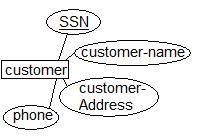
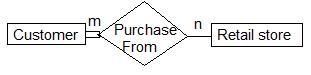
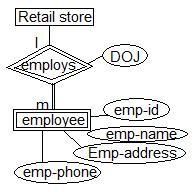
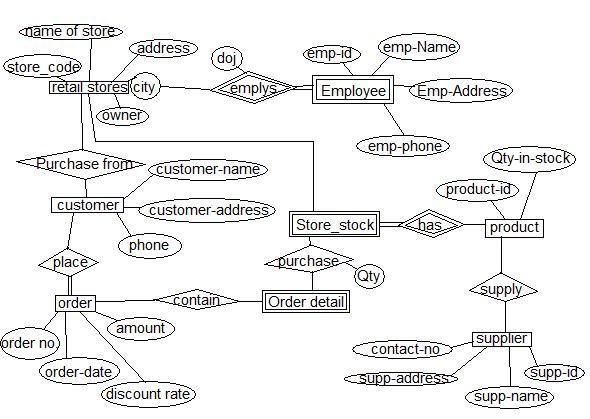
Question : 1 An organization has multiple ratail stores. These stores have to keep track of products, suppliers, customers and employees. Or else makes discounts offers on several items during festivals. Make an ER-diagramme statics assumptions used, if any. Use concept of keys, aggregation, generalisation cardinality etc. in a proper way.
Perform the following queries in SQL based on your ER-diagramme :
-- Find the details of products which have goy more than discount.
-- Find the details of stores which have maximum sales monthly.
-- Find details of employee who have been working with retails stores more than 15 years.
Ans:-
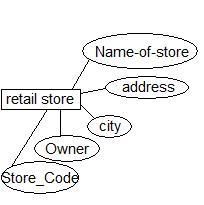
An organizational has multiple retail stores system stores information about each "retail stores" like Name-of store, Address, City, Owner, store_code. Store_code is unique for each retail store. So, store_code is a key attribute.
We create an Entity type "Retail Store" as belowb :
Fig 1
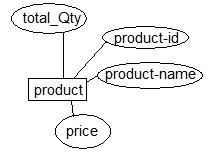
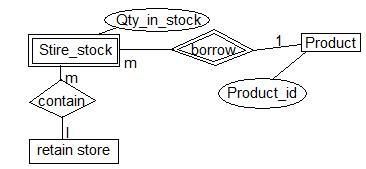
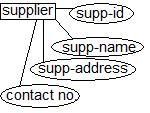
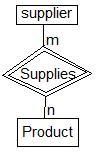

Ans.
Functions/Procedures/Methods:- functions are collection of programming statement written under a block and execute as a single unit.
two types of function we have in VB.
1. System Defined:- system defined function are also known as premitive function which are already defined and exist in VB liabrary. we have to use them as per our
requirment and convinient and they are as follows:-
i). Conversion functions:- like cint(),val(),Asc(),chr(),cbool(),cdate() and so on.
ii). Date Functions :- now,time,date,datediff,math,day
iii). string functions:- strreverse,strcomp,instr,mid and so on.
these system defined functions are very use full for us in our programe we donot need to develop the logic again and again to that work.
2. User Defined:-which are defined by us .
i). sub procedure
ii). function procedure
iii). property procedure
Examples:-
Print Asc("a")
Dim i As Integer
i = Asc("a")
Print i
Print Chr(97)
Dim str1 As String
str1 = "10"
Dim no As Integer
no = Val(str1)
Print no
str1 = str(no)
Print str1
Dim sdate As String
sdate = "2 january, 1994"
Dim dt As Date
dt = CDate(sdate)
Print dt
Private Sub Command9_Click()
'Removing spaces in the string
Dim str As String
str = " Bye "
str = LTrim(str)
Print str
Print str
str = RTrim(str)
Print str
str = Trim(str)
Print str
'Comparing string
Dim str1 As String
Dim str2 As String
str1 = "HELLO"
str2 = "hello"
'strcomp(
' -1 return str1 <>
' 0 return str1 = str2
' 1 return str1 > str2
'
'0 for binary
'1 for textual
Dim res As Integer
res = StrComp(str1, str2, 1)
Print res
res = StrComp(str1, str2, 0)
Print res
res = StrComp(str2, str1, 0)
Print res
'Reversing Strings
Dim strrev As String
strrev = "hello how are you"
strrev = StrReverse(strrev)
Print strrev
'Searching for a string within a string
Dim searched As String
Dim found As String
Dim startsearch As Integer
Dim comparetype As Integer
searched = "This is the good book"
found = "good"
startsearch = 1
comparetype = 1
Dim resu As Integer
resu = InStr(startsearch, searched, found, comparetype)
Print "The position=>" & resu
found = "good"
comparetype = 0
resu = InStr(startsearch, searched, found, comparetype)
Print resu
resu = InStr(searched, found)
Print resu
'0 for not found
'position no for found
'replace a part of the string
Dim strString As String
strString = "thank you"
Mid(strString, 1, 5) = "Oh My"
Print strString
Mid(strString, 7) = "God" '
Print strString
'changing the case
Dim ustr As String
Dim lstr As String
ustr = "HELLO"
lstr = "bye"
ustr = LCase(ustr)
'Print ustr
lstr = UCase(lstr)
'Print lstr
End Sub
Question : 1 Assume that a bookshop has database with the following scheme of six relations :
Authors (au_id, au_laname, au_frame, phone, address)
Publishers (pub_id, pub_name, city, state, country)
sales (stor_id, ord_name, stor_address, qty, title id)
stores (stor_id, stor_name, stor_address, city, state, zip)
Title author (au_id, title_id, royaltyper, au_ord)
Titles (title_id, title, type, pub_id, price, pubdate)
Write the following quries in relation algebra :
i- List the authors first and last names for the book titles ' life without fear '.
ii- List the title of the books sold at Barnum's. (Stor_name)
iii- Give the last name (au_lname) and au_ids of the authors whose have sold in the store named Barnum's. Assign an alias to your answer.
iv- Using your alias from the previous problem, give the last names and au_ids of the authors whose books have not sold in the store name Barnum's.
v- List the titles of books, which have not sold any copies at any store (no books sold at all).
vi- List titles of the books which have only sold at Barnum's. (Do not list the books which hava not sold anywhere).
vii- List the titles of the books, which lhave sold at both Barnum's and bookbeat. (Two stor_names).
viii- List the titles and store_names for each book when the book has sold and the title only (with null for the stor_name) if the book has not sold. (use an outer join).
ix- List the stor_ids of the stores which have sold all books published bu New Moon Books (pub_name).
x- List the titles of the books, which have sold at all stores.
Ans:
Query (i) : List the authors first and last names for the book titled 'life Without Fear'.
SQL .
Select au_lname, au_fname
From Authors
where au_id in (select au_id
from titleauthor
Where title_id in (select title_id
from titles
Where upper(title)='Life Without Fear'
)
)
Query (ii) : List the titles of the books sold at Barnum's. (stor_name)
SQL.
select title
from titles
Where title_id in (select title_id
from sales
where stor_id in(select stor_id
from stores
where upper(stor_name)='Barnum's'
)
)
Query (iii) : List titles of the books sold at Barnum's. (stor_name)
SQL.
select distinct au_lname "Last Name", au_id "Author ID"
from Titleauthor
where title_id in(select title_id
from sales
where stor_id in (select stor_id
from stores
where upper(stor_name)='Banum's'
)
)
Query (iv) : Using your alias from the previous problem, give the lastnames and au_ids of authors whose books have not sold in the store named Barnum's.
SQL.
(select distint au_lname"Last name, au_id"Author id"
from titleauthor
)
minus
(select distinct au_lname "last name", au_id "author id"
from titleauthor
where title_id in (select title_id
from sales
where stor_id in (select stor_id
from stores
where upper(stor_name)='Barnum's'
)
)
)
Query (v) : List the titles of books, which have not sold any copies at any store (no books sold at all).
SQL.
(select title from titles)
minus
(select title
from titles
where title_id in (select title_id
from sales
)
)
Query (vi) : List the titles of books, which have only sold at Barnum's (Do not list the books, which have sold anywhere).
SQL.
Select title
from titles T
where not exists(
(
select stor_id
from sales S
where S.title_id=T.title_id
)
minus
(
select stor_id
from stores
where upper(stor_name)='Barnum's'
)
)
Query(vii) : List the titles of the books, which have sold at both Barnum's and bookbeat (Two stor_names)
SQL.
select titles
where title_id in
(
(
select title_id
from sales
where stor_id in (select stor_id
from stores
where
upper(stor_name)='Bookbeat'
)
)
)
Query(viii) : List the titles and stor_names for each book when the book has sold and the title only (with null for the stor_name) if the book has not sold(Use an outor join)
SQL.
select title, stor_name "stor name"
from titles, stores
where titles.tiltle_id=stores.title_id(+);
Query(ix) : List the stor_ids of stores which have sold all books published by New Moon books (pub_name)
SQL.
select stor_id
from stores S
where not exists
(
(select title_id
from titles
where titles
where pub_id in (select pub_id
from publishers
where upper(pub_name)='New Moon books'
)
)
minus
(
select title_id
from stores SI
Where S.store_idSI.store_id
)
)
Query(x) : List the titles of the books, which have sold at all stores.
SQL.
select title
from title T
where not exists
(
(
select stor_id
from stores
)
minus
(
select store_id
from sales S
where S.title_id=T.Title_id)
)
Question : 2 Define the two principle integrity rules for the relational model. Discuss why it is disarable to enforce these rules?
Ans:
Intrgrity rules :-
The relational model includes two general integrity rules. These rules implicitly or explicitly define the set of consistent database states, or changes of sate, or both. Other integrity constraints can be specific, for example, in terms of dependencies during database design.
The principle integrity for the ralational model.
Entity integrity (Integrity Rule 1):-
In a relational database, entity integrity is a property that ensure that no records are duplicated and that no attributes that make up the primary key are NULL. It is one of the properties necessary to ensure the consistency of the database.
Entity Ingegrity ensures that are no duplicate records within the table and that the field that identifies each record within the table is unique and never null.
In a base table no column of a primary key can be null.
Intigrity rules are implicity or explicity define the set of consistent database states or changes of states or both.
Referential Integrity (Integrity Rule 2):-
Referential integrity in a relational database is consistency between coupled tables. Referential integrity usually enforced by the combination of a primary key or candidate key (alternate key) and a foreign key.
If a foreign key exists in a table, either the foreign key value must match wholly null.
Question : 3 What is a view? Discuss the difference between a view and a base relation. Explain what happens when a user accesses a batabase through a view.
Ans:
View: A relation that is a part of the physical databse, (e.g. A virtual relation) is made available to the users, is called a view.
Difference between a view and a base relation :-
| Views | Base relation |
| 1. This is one type of ralation which is not part of the physical database. | 1. A base relation is a relation that is not a derived relation. |
| 2. It has no direct or physical relation with the database. | 2. While it can manipulate the conceptual or physical relations stored in the data. |
| 3. Views can be used to provide security mechanism. | 3. It doesn't provide security. |
| 4. Modification through a view. (e.g. insert, update, delete) generally not permitted. | 4. Modification may be done with a base relation. |

 Posts
All Comments
Posts
All Comments


